Blood Tests in Railay
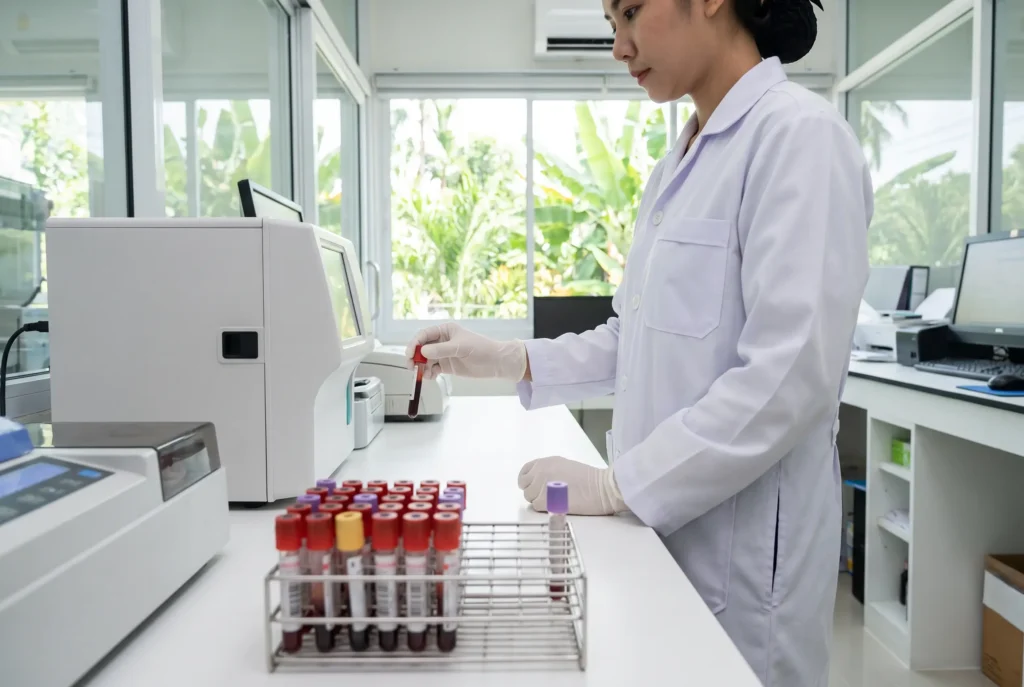
A fever on day three of a climbing trip is a different proposition from a fever at home. It could be a virus that will pass, or it could be dengue, and those two are managed very differently. Blood tests in Railay are processed in our own laboratory on the peninsula, so most results come back during the same visit rather than after a boat crossing and a day’s wait.
Tests we run on site
The panels that answer most of the questions a trip here raises:
- Dengue rapid test — NS1 antigen and antibodies
- Full blood count, which shows infection patterns and the falling platelets of dengue
- Malaria film, where the travel history calls for it
- Influenza and COVID swabs
- Liver and kidney function
- Blood glucose, HbA1c, cholesterol and thyroid
- Rapid HIV and syphilis
- Inflammatory markers such as CRP
Why a fever here gets a blood test
At home a short fever is usually watched for a few days, which is entirely reasonable. On a peninsula with no hospital that approach misses things at exactly the wrong moment.
Dengue is present in Krabi, and the moment it is a possibility the management changes — paracetamol only, no ibuprofen and no aspirin, because those affect platelets at the point when dengue is lowering them. A full blood count also separates a bacterial pattern from a viral one, which decides whether antibiotics will help at all.
Getting that answer in half an hour rather than after two days of guessing is the practical argument. See dengue fever and fever treatment.
How long results take
Rapid tests — dengue, HIV, syphilis, influenza, COVID — take about twenty minutes. Full blood counts and basic chemistry usually come back within the hour.
More specialised tests are sent to an external laboratory on the mainland and take one to three days, with the boat schedule adding a little to that. You do not have to wait at the clinic for send-out results; we message them to you, and where something needs acting on we call rather than leaving you to interpret numbers.
Do you need to fast?
For most tests, no. Come in as you are, particularly if you are unwell — nobody should be starving themselves while running a fever.
Fasting for eight to twelve hours matters for cholesterol and fasting glucose, so a health check up is best done first thing in the morning. Water is not only allowed during a fast but actively helps: dehydration makes the blood draw harder and shifts kidney results in a way that can look alarming and mean nothing.
Results that change what happens next
Some findings mean we keep you at the clinic, or move you to the mainland, rather than sending you back to your bungalow:
- Platelets falling in confirmed dengue, which needs monitoring and sometimes admission
- Markers suggesting severe bacterial infection
- Very high blood sugar in an unwell traveller
- Kidney function that has dropped significantly with dehydration
- Haemoglobin low enough to suggest bleeding somewhere
Where a result needs hospital care we arrange the crossing and send the results with you, so nobody repeats the tests from scratch — see evacuation and hospital transfer.
Making sense of your own results
You get a printed copy with your values alongside the reference ranges, and the nurse goes through what each one means in plain language.
Two things are worth understanding before you read them. A single value slightly outside a reference range is very often meaningless — ranges are defined so a percentage of perfectly healthy people fall outside them. And results move with circumstances: dehydration, a heavy night, a hard day of climbing and an acute infection all shift numbers temporarily.
Climbers in particular often see raised muscle enzymes after a big day, which looks alarming and usually is not. The pattern across several results, and the trend over time, matter far more than any single figure. Reports are issued in English with standard international ranges so any doctor can read them.
Frequently asked questions
How much do blood tests cost?
Each test is priced separately and a rapid dengue test or full blood count is inexpensive. Larger panels cost more, and you are given the price before any blood is taken.
Can I just ask for a test without being seen first?
You can request specific tests and we will run them. A short consultation first is usually better value, because the nurse may order the test that actually answers your question.
Can blood be taken at my resort?
Yes. On a doctor resort visit the sample is drawn in your room and processed back at the clinic.
How soon after a mosquito bite can dengue be detected?
The NS1 antigen is detectable from about the first day of fever, which is why we test on fever rather than on the bite. Testing before symptoms tells you nothing useful.
Will you explain the results?
Yes, in plain language, and you get a printed copy. That copy is also what your travel insurer will want if you claim.
Are the results accepted by nurses at home?
Yes. Reports are in English with standard international reference ranges, so any doctor can read them without translation.
A nurse-led clinic, part of the Takecare network
Takecare Clinic Railay is staffed by experienced English-speaking nurses, and works together with Doctor Ao Nang Takecare Medical Clinic in Ao Nang. The two clinics share doctors, records and treatment plans, so a doctor is involved whenever one is needed — reviewing a case, prescribing, or coming over to Railay — and care started on the peninsula continues without repetition if you cross to the mainland. It also means a second clinical opinion is a phone call away rather than a boat ride.
Come in, or we come to you
Takecare Clinic Railay is open 8am–10pm daily on Railay, and reachable 24 hours by phone, WhatsApp and Line — so if something happens after we close, message rather than wait until morning. Walk in without an appointment, call +66 81 718 9080, message WhatsApp or Line. If you would rather not move, ask for a doctor resort visit and we will come to you. For anything that cannot wait for a boat, see evacuation and hospital transfer.