Suture Removal in Railay
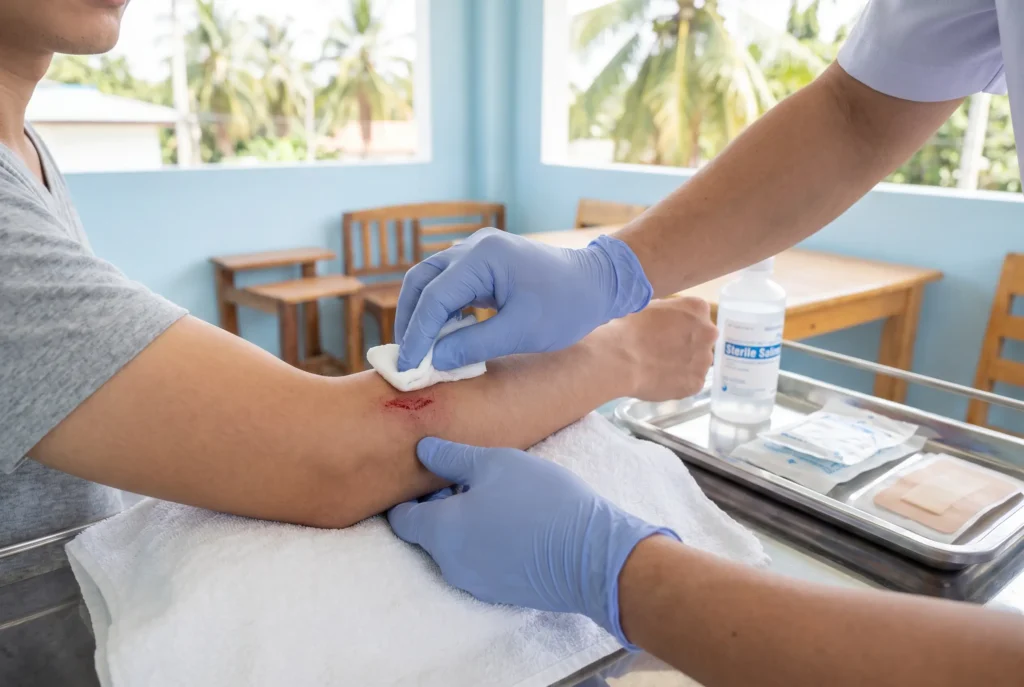
You were stitched somewhere else — a clinic in Ao Nang, a hospital in Krabi, an emergency department before you flew — and the removal date has arrived while you are on Railay. Suture removal in Railay takes about five minutes, costs very little, and needs none of the paperwork from wherever the stitches were put in.
You do not need to go back to whoever stitched you
This is the most common worry and it is entirely unfounded. Any competent clinic can remove sutures. We do not need the original notes, the original doctor, a referral, or an explanation — which is just as well, since going back to a mainland clinic from here means a boat each way.
Bring the wound and, if you happen to have it, whatever paperwork you were given. If you are not sure how many stitches went in, we count them out and check the line carefully afterwards. That matters, because a single missed suture buried under healed skin causes a stubborn little abscess weeks later, usually after you have flown home.
When stitches should come out
Timing is dictated by the body part rather than how tidy the wound looks:
- Face: 5 days
- Scalp and neck: 7 days
- Arms and hands: 10 days
- Trunk and back: 10 to 14 days
- Legs, knees and feet: 14 days
Too early and the wound can pull apart under tension. Too late and the suture marks become permanent. If you are unsure of the date, come in anyway and it will be judged on how the wound has healed rather than on arithmetic.
What it feels like
Very little, and considerably less than people brace for. The nurse cleans the area, lifts each knot with forceps, cuts one side of the loop and draws the thread through. Most people describe a small tug.
No anaesthetic is needed and there is no injection. Removing eight or ten sutures takes about five minutes. Afterwards the wound is cleaned and covered with a light dressing, and you are shown how to support the scar over the following weeks.
When the wound is not ready
Sometimes the dressing comes off and the wound plainly is not healed enough. That is not a failure and forcing it would be a genuine mistake.
In that case we remove alternate sutures to release tension, re-dress it, and bring you back in a few days. If the wound looks infected the priority changes entirely — spreading redness, yellow discharge, heat and increasing pain mean cellulitis needs treating before or alongside removal.
Wounds heal more slowly here than people expect, because humidity, salt and sun all work against them. A date that would have been right in Europe is sometimes two or three days early on Railay.
Looking after the scar afterwards
The wound is closed but nowhere near strong. At the moment sutures come out it has only a fraction of its final strength, and it keeps building for months. That gap is why wounds reopen on the first day of freedom.
- No swimming for two more days after removal
- Avoid stretching or loading the area for about two weeks — for climbers that means the hand and forearm specifically
- Keep the scar out of direct sun for six months, or use high-factor sunblock on it
- Once fully healed, massage the scar gently with a plain moisturiser
If the wound was over a knee, ankle or knuckle, take the first days gently. Scars over joints reopen more often than anywhere else, and here it is almost always on a beach walk or a warm-up route that felt fine at the time.
Staples, glue and dissolvable stitches
Not everything needs removing, and it helps to know which you have.
Dissolvable sutures break down on their own over one to three weeks and need no appointment, though loose ends can catch and irritate and can be trimmed. Skin glue peels off over five to ten days and should be left alone rather than picked. Surgical staples do need removing with a proper staple remover rather than improvisation, and we have one.
If you genuinely do not know what you have, come in and we will look. It takes a minute and saves either an unnecessary trip or a set of stitches left in far too long — and ongoing wound dressing can be handled at the same visit.
Frequently asked questions
How much does suture removal cost?
It is one of the least expensive things we do — a short nurse appointment. Re-dressing or treating an infection is charged separately and quoted first.
Do I need the paperwork from the clinic that stitched me?
No. It helps if you have it, but sutures can be removed without any documentation at all.
Can I have them removed at my resort?
Yes. A doctor resort visit can include removal, though the clinic has better light for checking the healed line properly.
Does it hurt?
Not really. Most people are surprised how quick and painless it is compared with having the stitches put in.
What if I leave Railay before they are due out?
Come in anyway. We check the wound, re-dress it, and give you a letter stating the date and number of sutures so any clinic can finish the job.
How do I know if mine are dissolvable?
Dissolvable sutures are often clear or light violet and soften over a couple of weeks. If you are unsure, come in — it takes a minute to tell, and guessing wrong means either a wasted trip or stitches left in far too long.
A nurse-led clinic, part of the Takecare network
Takecare Clinic Railay is staffed by experienced English-speaking nurses, and works together with Doctor Ao Nang Takecare Medical Clinic in Ao Nang. The two clinics share doctors, records and treatment plans, so a doctor is involved whenever one is needed — reviewing a case, prescribing, or coming over to Railay — and care started on the peninsula continues without repetition if you cross to the mainland. It also means a second clinical opinion is a phone call away rather than a boat ride.
Come in, or we come to you
Takecare Clinic Railay is open 8am–10pm daily on Railay, and reachable 24 hours by phone, WhatsApp and Line — so if something happens after we close, message rather than wait until morning. Walk in without an appointment, call +66 81 718 9080, message WhatsApp or Line. If you would rather not move, ask for a doctor resort visit and we will come to you. For anything that cannot wait for a boat, see evacuation and hospital transfer.