Wound Dressing in Railay
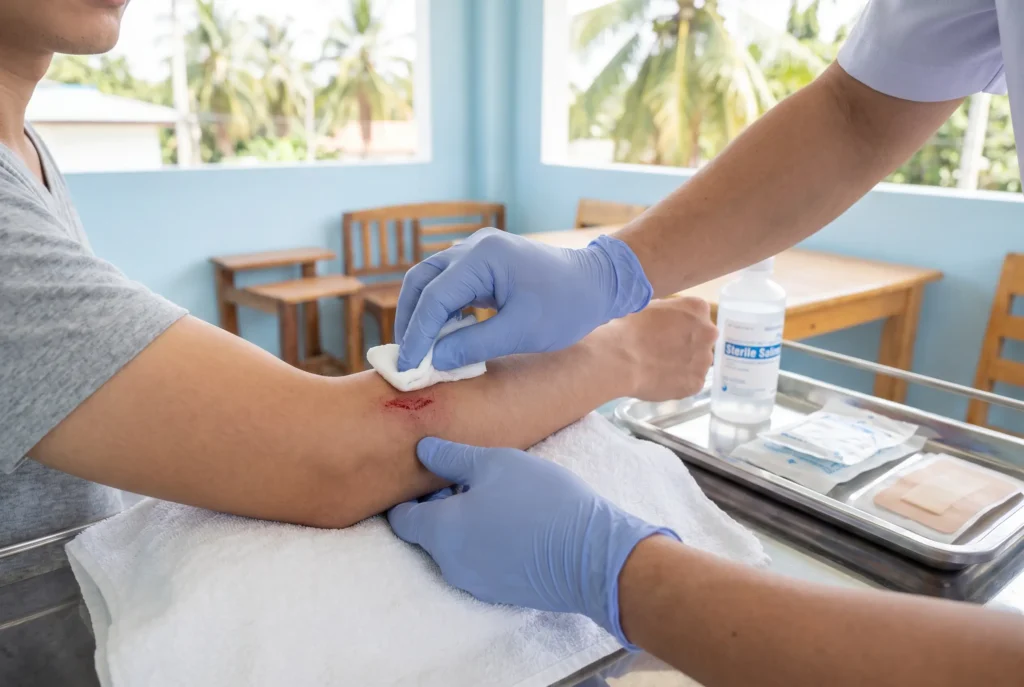
Limestone is sharp, wet rock is sharper, and the shoreline here is full of things that cut. A graze from a slab, a hand opened on a hold, a foot sliced on rock at the tide line — none of it feels worth a nurse until day three, when the edges go red and it starts to throb. Wound dressing in Railay is a ten-minute job that routinely saves people the back half of a trip.
Why wounds go wrong faster here
Heat and humidity keep skin permanently slightly damp, and damp skin under a soggy plaster is close to ideal for bacteria. Sea water and wet rock carry organisms that simply are not present in temperate climates.
On top of that, people keep using the injury. They climb on a split hand, swim with an open graze, walk the beach path on a cut foot. Chalk goes into wounds constantly and is not sterile. The result is that minor injuries here progress to cellulitis far more often than the same injury would at home.
Limestone deserves a specific mention. It is abrasive and dirty, and cuts from it tend to carry grit and organic material deep into the wound rather than sitting on the surface.
What a proper dressing involves
Cleaning the wound out is the part that matters and the part almost everyone skips. We irrigate thoroughly with sterile solution, remove grit and dead tissue, and check how deep it actually goes — grazes very often hide a deeper laceration in one corner that needs stitches.
Then it is dressed with a material chosen for that wound rather than whatever is nearest. A weeping graze needs something absorbent; a dry shallow cut needs something that holds a little moisture in; a wound over a knuckle needs a dressing that survives bending.
We also check whether your tetanus cover is current, which for most travellers it quietly is not.
Daily changes while you are still here
Most wounds need re-dressing every one to three days. You are welcome to come in for each change and plenty of people fold it into the walk past on the way to breakfast.
If you would rather manage it yourself, we send you away with the right materials and show you how, which is more useful than a leaflet. If you had stitches put in somewhere else — Ao Nang, Krabi, another country — we will take over the dressings and handle the suture removal when the date comes, without needing the original paperwork.
How to tell a wound is infected
Come back the same day if you notice:
- Redness spreading outward, especially in a line up the limb
- Pain increasing after day two, when it should be settling
- Yellow or green discharge, or a smell
- Skin around it feeling hot and tight
- A fever, or feeling generally unwell
A red streak travelling up an arm or leg is the one to act on rather than sleep on. That is infection moving through the lymphatic system and it needs antibiotics today — which on Railay means today at the clinic, not tomorrow after a boat.
Keeping a wound dry on a beach and a rock
This is the awkward part and pretending otherwise helps nobody. A wound soaked daily in sea water will not heal on schedule, and there is no dressing that fully solves it.
Waterproof dressings work for a short swim, not an afternoon in the sea. For the first forty-eight hours after any fresh wound, stay out of the water. Sand works under the edge of a dressing and grinds with every step.
For climbers there is a second problem: chalk. It dries the wound edge, it is not sterile, and taping over an open wound to climb traps moisture and dirt against it. Give a hand wound two or three days properly and it closes; climb on it daily and it stays open for a fortnight.
Wounds that need more than a dressing
Some injuries need assessment before anything gets covered. Come in rather than dressing it yourself if there is a wound you cannot see the bottom of, anything with grit you cannot flush out, a puncture from a rock spike or a tooth, a wound over a joint that gapes when you bend, or any hand injury affecting how a finger moves.
Hand wounds deserve particular respect on a climbing trip. Difficulty bending or straightening a finger after a cut suggests tendon involvement and needs assessment the same day rather than a plaster and optimism — see climbing finger injury. Monkey bites are never simply dressed and closed; they are washed out and generally left open on purpose.
Frequently asked questions
How much does wound dressing cost?
A dressing change is charged as a short nurse visit plus materials and is one of the least expensive things we do. The first visit costs more because it includes the nurse cleaning and assessing the wound.
Can you re-dress a wound treated somewhere else?
Yes, and it is common. Bring any paperwork if you have it, but we can take over without it.
Do I need a tetanus shot?
If your last one was more than five years ago and the wound was dirty or deep, yes. It can be given at the same visit — see travel vaccinations.
Can someone come to my room to change the dressing?
Yes. For anyone struggling to walk, a doctor resort visit can cover the daily change across Railay and Tonsai.
Should I let it dry out or keep it covered?
Keep it covered. The old advice about letting wounds breathe is wrong — a lightly moist, covered wound heals faster and scars less than one left to form a hard scab.
Can I climb with a taped-over cut?
You can, and it will take considerably longer to heal. Chalk and tape trap dirt and moisture against the wound. Two or three days off usually costs less climbing overall than two weeks of a wound that keeps reopening.
A nurse-led clinic, part of the Takecare network
Takecare Clinic Railay is staffed by experienced English-speaking nurses, and works together with Doctor Ao Nang Takecare Medical Clinic in Ao Nang. The two clinics share doctors, records and treatment plans, so a doctor is involved whenever one is needed — reviewing a case, prescribing, or coming over to Railay — and care started on the peninsula continues without repetition if you cross to the mainland. It also means a second clinical opinion is a phone call away rather than a boat ride.
Come in, or we come to you
Takecare Clinic Railay is open 8am–10pm daily on Railay, and reachable 24 hours by phone, WhatsApp and Line — so if something happens after we close, message rather than wait until morning. Walk in without an appointment, call +66 81 718 9080, message WhatsApp or Line. If you would rather not move, ask for a doctor resort visit and we will come to you. For anything that cannot wait for a boat, see evacuation and hospital transfer.