Climbing finger injury treatment in Railay
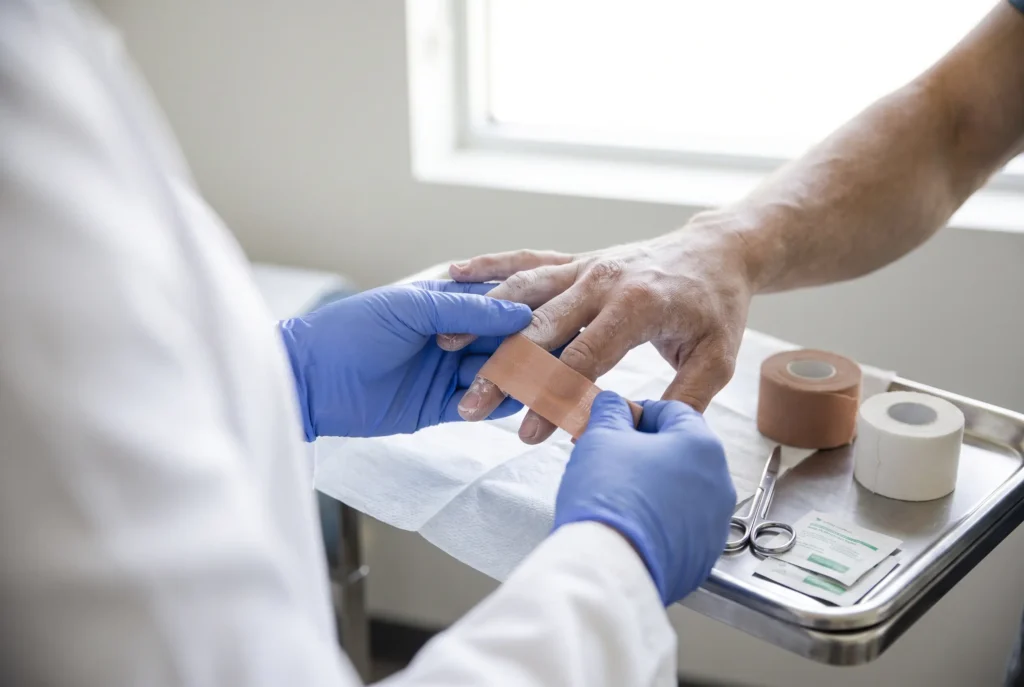
Something popped on a crimp and now the finger aches at the base and does not want to load. Or the skin has gone entirely and every hold feels like sandpaper. Fingers are what climbers actually injure, and Railay’s sharp limestone crimps produce both problems in quantity. Climbing finger injury treatment in Railay starts with separating the injuries you can climb around from the ones that cost months if you do.
Pulley injuries — the pop everyone dreads
The pulleys are fibrous bands holding the flexor tendons against the finger bones. Overload them, usually while crimping, and they strain or rupture. The A2 pulley at the base of the finger is the classic.
A strain hurts at the base of the finger, is tender to press there, and hurts more on crimping than on open-handed holds. A full rupture often comes with an audible or felt pop, and in significant cases the tendon bowstrings — you can see or feel it lift away from the bone when you flex against resistance.
That distinction matters enormously. A strain is managed with load reduction and taping and recovers in weeks. A rupture needs proper immobilisation, a structured return, and occasionally surgical opinion — and climbing through it turns a season into a year.
What to do immediately
Stop climbing that day. Not “finish the route” — that is how a strain becomes a rupture.
Ice the finger for fifteen minutes a couple of times in the first day or two. Take an anti-inflammatory if you have no reason to avoid it. Keep moving the finger gently through a pain-free range; complete immobility stiffens a finger fast and is rarely the right answer for a simple strain.
Do not tape it tightly and carry on. Tape provides far less mechanical support than most climbers believe, and its main value is proprioceptive reminder rather than load sharing.
The other finger injuries we see
Not everything that hurts is a pulley:
- Flexor tendon strains, which hurt along the finger rather than at one point
- Collateral ligament sprains of the finger joints, common after a jam or a catch
- Joint capsule inflammation from high volume on small holds
- Torn skin — flappers and split tips, which are wounds rather than injuries
- Subungual haematoma, blood under a nail after a crush
- Infected splits, which happen readily in this humidity
The one that must not be missed is a wound affecting how the finger moves. If you cannot bend or straighten it through its normal range after a cut, treat that as a tendon injury until a surgeon says otherwise — see wound care and get seen the same day.
Skin — the injury nobody counts
On Railay’s limestone, skin is the limiting factor for most people before tendons are. Sharp crimps, humidity and salt combine to make skin soft and then to tear it.
A flapper should be trimmed cleanly rather than left hanging, cleaned properly, and dressed. Chalk in an open split is dirt in a wound. Superglue on cracked tips is widely used and is reasonable on clean, dry, closed splits — it is not appropriate on a dirty or actively bleeding wound, and it seals infection in beautifully if applied to one.
Skin recovers overnight if you let it and not at all if you climb daily on it. Sanding down calluses before they tear, drying hands properly, and taking a genuine rest day work better than any product.
What we do
The nurse examines the specific structure — where exactly the tenderness sits, how it behaves against resistance, whether there is bowstringing, and whether the joint is stable.
From that you get an honest answer on what it is, whether you can climb and at what intensity, how to tape it usefully, and when to expect recovery. Wounds are cleaned and dressed properly, and tetanus cover is checked.
Where a rupture or tendon injury is likely, we refer for imaging and specialist opinion in Krabi Town with written findings — see hospital transfer for how that works from here.
Getting back to climbing
For a pulley strain, the usual pattern is a week or two off, then easy climbing on large open-handed holds, avoiding crimps entirely for several weeks, with tape as a reminder. Progress by how it feels the following morning rather than during the session.
The single most important point: pulley injuries reinjure easily, and a second injury to the same finger takes considerably longer than the first. The temptation on a trip with a fixed end date is to push it. That is exactly the calculation that turns three weeks into six months.
Warm up properly before hard crimping — most pulley injuries happen on the first or second hard move of the day. And if this is the third finger problem this season, that is a load management issue rather than bad luck, and worth discussing.
Frequently asked questions
I heard a pop. Is it ruptured?
Not necessarily — many strains pop audibly. What distinguishes them is bowstringing, the degree of swelling, and how it behaves against resistance, which is what the examination checks.
How much does an assessment cost?
A consultation with examination and taping advice is inexpensive. Wound treatment, imaging referral or medication is added and quoted first.
Can I climb on it?
Often yes, at reduced intensity and off crimps. You will get a specific answer rather than a blanket no, because “stop climbing entirely” is advice most people ignore anyway.
Does taping actually help?
Less than most climbers think, mechanically. Its real value is as a reminder not to crimp and as protection for skin. It is not a substitute for reducing load.
Should I superglue a split tip?
On a clean, dry, closed split it is reasonable and widely done. Never on a dirty or bleeding wound — it seals infection in. If it is deep or will not stop bleeding, get it cleaned properly first.
How long until I can crimp again?
A mild strain, two to four weeks with a gradual return. A significant one, considerably longer. Progress by how the finger feels the next morning rather than how it feels mid-session.
A nurse-led clinic, part of the Takecare network
Takecare Clinic Railay is staffed by experienced English-speaking nurses, and works together with Doctor Ao Nang Takecare Medical Clinic in Ao Nang. The two clinics share doctors, records and treatment plans, so a doctor is involved whenever one is needed — reviewing a case, prescribing, or coming over to Railay — and care started on the peninsula continues without repetition if you cross to the mainland. It also means a second clinical opinion is a phone call away rather than a boat ride.
Come in, or we come to you
Takecare Clinic Railay is open 8am–10pm daily on Railay, and reachable 24 hours by phone, WhatsApp and Line — so if something happens after we close, message rather than wait until morning. Walk in without an appointment, call +66 81 718 9080, message WhatsApp or Line. If you would rather not move, ask for a doctor resort visit and we will come to you. For anything that cannot wait for a boat, see evacuation and hospital transfer.