Sea urchin spine treatment in Railay
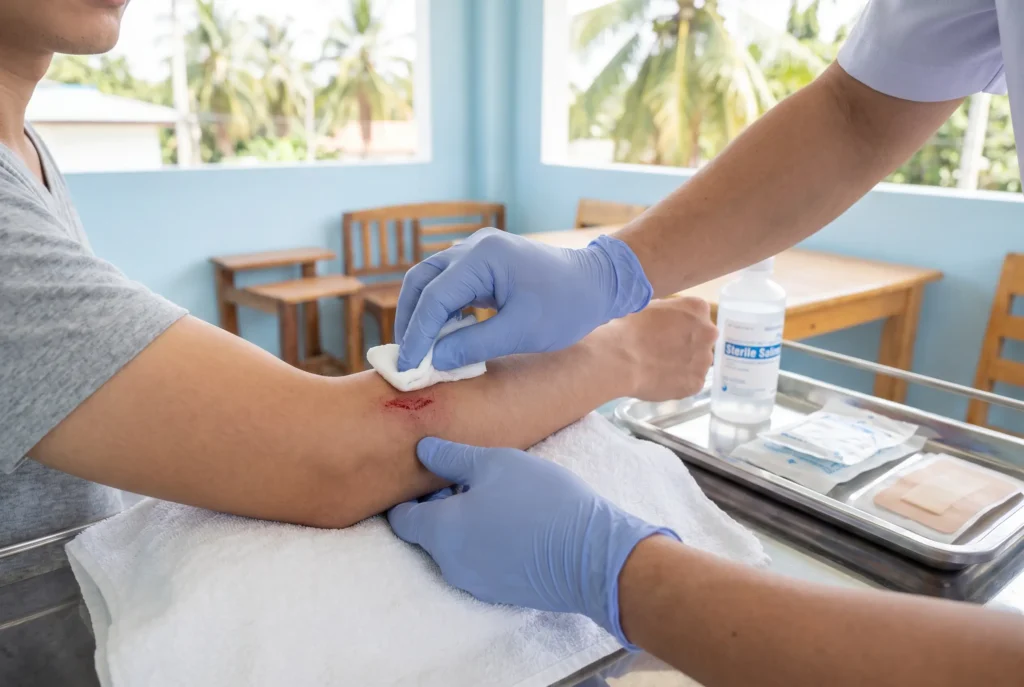
You stepped off the boat onto what looked like flat rock, or put a foot down while swimming near the tide line, and now there are black dots in your heel that hurt with every step. The limestone shoreline here is full of urchins and they are hard to see against dark rock. Sea urchin spine treatment in Railay is a routine procedure on this peninsula, and doing it properly beats two days with a needle and a headtorch.
What actually happens when you stand on one
Urchin spines are brittle and often barbed. They penetrate skin easily and then snap when you try to grip them, leaving the visible tip in your fingers and the rest of the spine deeper in the tissue.
Some species also carry mild venom, which is why the initial pain is out of proportion to the size of the puncture. The black staining you see is usually pigment from the spine rather than the spine itself, and pigment alone will fade without treatment — which is why not every black dot means a retained spine.
The genuine problems are retained fragments causing persistent infection, and spines that have penetrated a joint or deep into the sole of the foot.
What to do straight away
Get out of the water carefully, because standing on more of them is the classic sequel.
Immerse the area in water as hot as you can tolerate without scalding, for thirty to ninety minutes. This genuinely helps — the venom proteins break down with heat, and it is the single most effective thing for the pain. Test the temperature with an uninjured hand, because a numb foot cannot judge it and a scald on top of this is a worse problem.
Remove any spines you can grip easily with tweezers, without digging. Do not attack it with a needle, and do not use the widely repeated urine or vinegar remedies — vinegar helps for some marine stings but does not dissolve spines.
Which spines need removing
Not all of them, and this is where being seen saves you two days of unnecessary excavation.
Spines that are superficial, palpable, in the hand, near a joint, or causing ongoing pain generally come out. Very small deep fragments in soft tissue of the foot are sometimes better left, because digging for them causes more tissue damage than the fragment will, and the body will often absorb or extrude them over weeks.
The judgement depends on depth, location and whether the tissue is already inflamed. Under a local anaesthetic block with proper light and instruments, removal is straightforward — see minor surgery.
Infection is the real risk
Marine wounds infect readily and with organisms that are not the usual skin bacteria, including Vibrio species that do not respond to the antibiotics most people carry.
Come back the same day if there is spreading redness, increasing pain after day two, swelling and heat, discharge, a red streak up the leg, or fever. That is cellulitis and needs treating promptly, with an antibiotic chosen for marine organisms rather than a leftover course from home.
Tetanus cover is checked as a matter of routine, because these are dirty puncture wounds — see travel vaccinations if yours has lapsed.
Living with it for the rest of the trip
A foot full of spines is a walking problem, and on Railay walking is transport. Expect a few uncomfortable days, and take the pressure off where you can.
Stay out of the sea until the punctures have closed. Keep the area clean and dry, change dressings after any beach time, and do not climb in tight shoes on a freshly treated foot — the pressure over a puncture is genuinely painful and slows healing.
Persistent pain weeks later, a lump that will not settle, or a spot that keeps discharging usually means a retained fragment or a granuloma, and it needs looking at rather than waiting out.
Avoiding them
Urchins sit in exactly the places people step: shallow rocky shelves, the base of the cliffs, around boat landings and on the walk out at low tide.
Reef shoes are the whole answer and almost nobody wears them. If you are getting on or off a longtail in shallow water, walking a rocky shoreline, or scrambling at the tide line, wear something on your feet. Shuffle rather than stepping down firmly, and look before you place a hand on submerged rock.
Take particular care at dusk and in murky water after rain, when they are effectively invisible. And if you are deep water soloing, remember the exit is often the shallow rocky bit — see coral and limestone cuts for the other half of the same problem.
Frequently asked questions
Do all the spines have to come out?
No. Superficial, palpable spines and any near a joint or in the hand generally do. Small deep fragments in the foot are sometimes better left, because removing them causes more damage than they will.
How much does removal cost?
It is priced as a short procedure with local anaesthetic where needed, and is inexpensive. You are quoted before it starts.
Does hot water really help?
Yes, and it is the most effective immediate treatment for pain. As hot as tolerable, for thirty to ninety minutes — but test the temperature with an uninjured hand.
The black marks are still there. Are spines left in?
Often not. Much of the black staining is pigment rather than spine, and it fades over weeks. Persistent pain, a lump or discharge is what suggests a retained fragment.
Can I swim or climb afterwards?
Stay out of the sea until the punctures close. Climbing in tight shoes on a treated foot is painful and slows healing — give it a few days.
Can a doctor come to me?
Yes for assessment and dressings on a doctor resort visit, though removal is much better done at the clinic with proper light and instruments.
A nurse-led clinic, part of the Takecare network
Takecare Clinic Railay is staffed by experienced English-speaking nurses, and works together with Doctor Ao Nang Takecare Medical Clinic in Ao Nang. The two clinics share doctors, records and treatment plans, so a doctor is involved whenever one is needed — reviewing a case, prescribing, or coming over to Railay — and care started on the peninsula continues without repetition if you cross to the mainland. It also means a second clinical opinion is a phone call away rather than a boat ride.
Come in, or we come to you
Takecare Clinic Railay is open 8am–10pm daily on Railay, and reachable 24 hours by phone, WhatsApp and Line — so if something happens after we close, message rather than wait until morning. Walk in without an appointment, call +66 81 718 9080, message WhatsApp or Line. If you would rather not move, ask for a doctor resort visit and we will come to you. For anything that cannot wait for a boat, see evacuation and hospital transfer.