Coral cut treatment in Railay
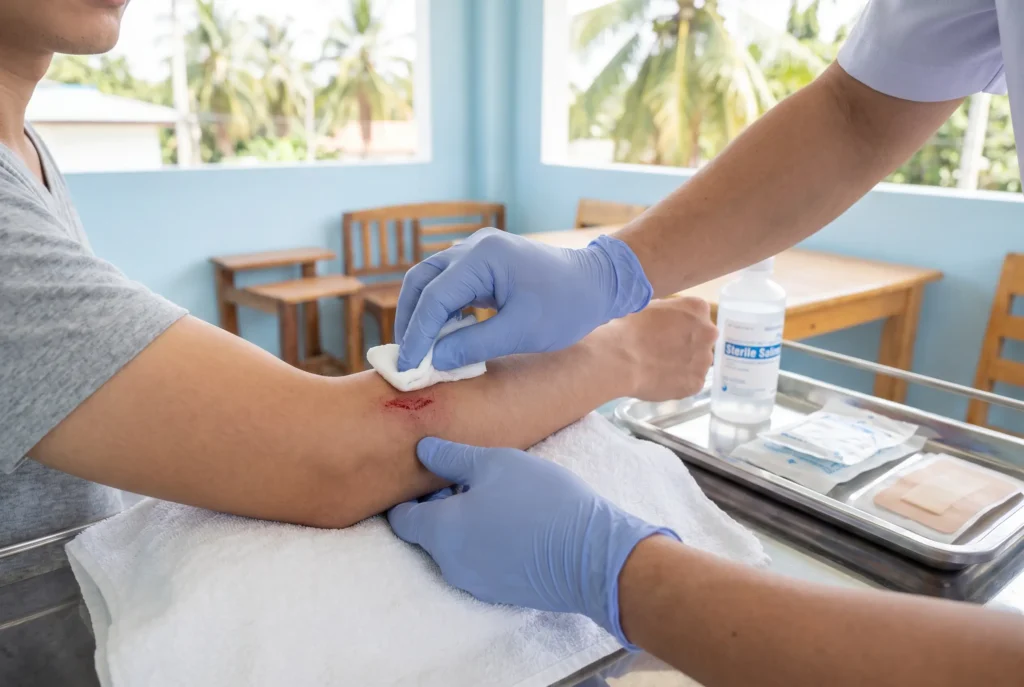
A hand put down on rock while swimming, a shin caught getting back onto the boat, a scrape on the exit from a deep water solo. Limestone and coral cuts look trivial and behave badly — three days later the edges are red and it refuses to heal. Coral cut treatment in Railay is about cleaning it out properly before it becomes the thing that defines your trip.
Why these cuts turn nasty
Three things happen at once. Fragments of coral, limestone and calcium break off into the wound and act as foreign bodies the skin cannot expel. Living organisms and stinging cells from the coral surface cause an inflammatory reaction of their own. And marine bacteria get in, including Vibrio species that do not exist on land and do not respond to the antibiotics people typically carry.
Railay adds limestone to the usual coral problem. The rock here is abrasive and dirty, and a scrape on wet limestone drives grit and organic material deep rather than leaving it on the surface.
The result is that a shallow scrape which would heal in days at home can become a deep, stubborn infection here within seventy-two hours.
What to do straight away
Get out of the water and rinse the wound with clean fresh water. For coral and limestone cuts, unlike jellyfish stings, fresh water is exactly right.
Scrub gently to lift out fragments. It is uncomfortable and it is necessary — this step determines how the next two weeks go. Use tweezers for anything visible, then clean with antiseptic and cover with a clean dry dressing.
Do not stitch or tape a coral wound closed, and do not let anyone else do so. Closing bacteria and fragments inside is precisely how these become abscesses.
Signs it is infected
Come in the same day if you see:
- Redness spreading outward from the wound
- Increasing pain after day two
- Swelling, heat and tightness around it
- Pus or discharge
- A red streak running up the limb
- Fever or feeling generally unwell
A red streak travelling up the leg or arm means infection is moving through the lymphatic system, and that needs antibiotics today — see cellulitis treatment. On a peninsula where tomorrow means a boat, today matters.
How we treat it
The wound is cleaned thoroughly under local anaesthetic where needed, and every fragment we can find is removed. That thorough clean is essentially the whole treatment and it is the part most people skip when managing it themselves.
Tetanus cover is checked and a booster given if due. Antibiotics are used where there are signs of infection, and the choice genuinely matters — marine bacteria do not reliably respond to the antibiotics used for ordinary skin infections, so this is a poor wound to self-treat with leftover tablets.
You will need dressing changes every day or two until it closes.
Healing while you are still here
Stay out of the sea until the wound has closed. This is the difficult part and it is not negotiable — going back into the water with an open coral wound is the reliable way to turn a minor injury into a fortnight of antibiotics.
Keep it covered during the day, change the dressing after showering, and let air at it overnight in a clean room. Expect it to take longer than an equivalent graze at home, frequently two weeks or more.
For climbers there is the extra problem of chalk, which is not sterile and dries the wound edge. Climbing on a hand cut with tape over it keeps it open for a fortnight; two or three days off usually costs less climbing overall.
Avoiding them on this coastline
Nearly every cut we treat is on a shin, a knee, a foot or a hand, and nearly all happen in the same few situations: standing up in shallow water, getting on or off a longtail, steadying yourself on submerged rock, or exiting a deep water solo.
The single most effective measure is not touching the bottom. Beyond that: reef shoes, a rash vest that covers the forearms, gloves when handling boat ladders, and looking before placing a hand on submerged rock.
Fire coral and hydroids sting as well as cut, producing a burning welt alongside the graze — that is treated more like a jellyfish sting in the first minutes, with wound care afterwards. And urchin spines live in exactly the same places, so the two injuries frequently arrive together.
Frequently asked questions
How much does treatment cost?
The first visit costs most, as it includes the nurse, cleaning, any anaesthetic and the dressing. Follow-up dressing changes are charged as short nurse visits.
Do I need a tetanus injection?
If your last one was more than five years ago, yes. These wounds are dirty by definition — see travel vaccinations.
Can I keep swimming or climbing?
Not with an open wound. Sea water reinfects it and chalk keeps it open. Once it has closed and there is no redness you can go back in.
Why is it not healing?
Almost always a fragment left in the wound, or repeated sea water exposure. Both are fixable, and both need the wound looked at rather than another cream.
Can a doctor come to me?
Yes for dressing changes on a doctor resort visit. The first thorough clean is better at the clinic with proper light and instruments.
How long until it heals?
A shallow, well-cleaned cut closes in about ten days. A deeper one, or one that keeps getting wet, takes two to three weeks and sometimes longer.
A nurse-led clinic, part of the Takecare network
Takecare Clinic Railay is staffed by experienced English-speaking nurses, and works together with Doctor Ao Nang Takecare Medical Clinic in Ao Nang. The two clinics share doctors, records and treatment plans, so a doctor is involved whenever one is needed — reviewing a case, prescribing, or coming over to Railay — and care started on the peninsula continues without repetition if you cross to the mainland. It also means a second clinical opinion is a phone call away rather than a boat ride.
Come in, or we come to you
Takecare Clinic Railay is open 8am–10pm daily on Railay, and reachable 24 hours by phone, WhatsApp and Line — so if something happens after we close, message rather than wait until morning. Walk in without an appointment, call +66 81 718 9080, message WhatsApp or Line. If you would rather not move, ask for a doctor resort visit and we will come to you. For anything that cannot wait for a boat, see evacuation and hospital transfer.