Stitches and Laceration Repair in Railay
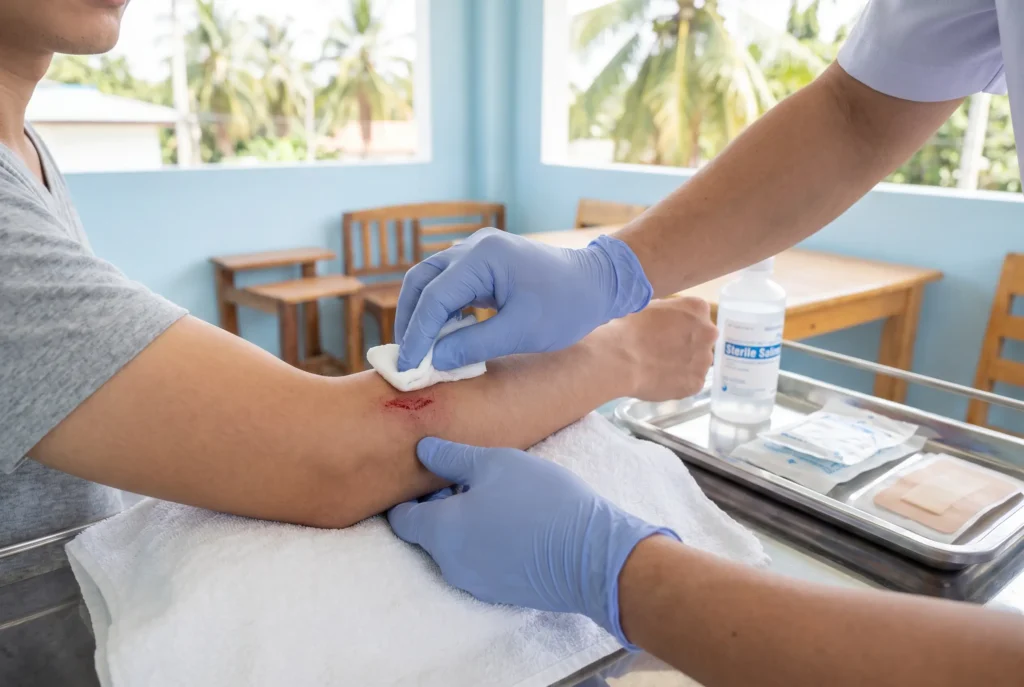
Wet rock at the tide line, a slip on the path in the dark, a hold that broke. The cut is deeper than it first looked and the edges will not stay together. There is a real time window most people do not know about: stitches in Railay work best within about six hours of the injury, and after roughly twelve the risk of sealing infection inside the wound becomes too high to close it at all.
Which cuts need closing
Not every cut needs stitches, and closing one that does not is its own small harm. These usually do:
- Anything deeper than about half a centimetre, or where the edges gape when the skin is relaxed
- Cuts longer than roughly two centimetres
- Wounds where you can see fat, muscle or bone
- Cuts across a joint, on the palm, or on the sole of the foot
- Any facial cut, where the eventual scar matters
- Bleeding that restarts every time pressure comes off
A rough test: if you can pinch it closed and it stays, it may heal well with a dressing. If it springs open, come in — and come in today rather than after tomorrow’s climbing.
Stitches, glue or adhesive strips
Three ways to close a wound, and they are not interchangeable.
Stitches are strongest and are used for anything deep, gaping, or on a part of the body that moves and stretches. Skin glue suits short, clean, straight cuts whose edges already sit together, and is the usual choice for children’s foreheads. Adhesive strips work for shallow cuts in skin that is not under tension, and fail quickly anywhere sweaty — which here is everywhere.
The nurse chooses based on the wound rather than what is quickest, and will explain why.
What happens during the procedure
The wound is cleaned and numbed with local anaesthetic. The injection stings for a few seconds — that is the worst part — and after that you feel pressure and movement but no pain.
The wound is then washed out thoroughly. That step takes longer than the stitching itself and is what prevents infection, so it is worth being patient through, particularly with limestone cuts that carry grit.
Closing a typical cut takes ten to twenty minutes. You leave with a dressing, written aftercare, a tetanus booster if due, and a date for suture removal.
When the stitches come out
Timing depends on where the wound is, because tension varies enormously across the body:
- Face: 5 days
- Scalp and neck: 7 days
- Arms and hands: 10 days
- Trunk and back: 10 to 14 days
- Legs, knees and feet: 14 days
Left in too long, sutures leave permanent dotted marks either side of the scar. Taken out too early, the wound can open. If you are moving on before the date, we give you the number of sutures and the date in writing so any clinic anywhere can finish the job.
Aftercare on a beach, and when to come straight back
Keep it completely dry for forty-eight hours, then you may shower briefly and pat it dry. No sea, no swimming and no long soaking until the stitches are out. This is the rule people break here more than anywhere, and it is the single most common reason a stitched wound gets infected.
Come back the same day if the wound reopens, if pain increases after day two, if redness spreads outward, if there is yellow discharge, or if you develop a fever.
Keep the healing scar out of direct sun for six months or it will darken permanently — which on a peninsula where you are outdoors all day means covering it rather than relying on intention.
If it is already too late to stitch
Plenty of people arrive a day or two later, having hoped it would sort itself out. That is not a wasted trip and nobody will tell you off.
Beyond about twelve hours the wound is generally cleaned thoroughly and left to heal open, with regular dressing changes. It takes longer and the scar is a little wider, but sealing bacteria inside a wound causes a far worse outcome than a broader line.
Where a wound is already infected, that is treated first — see cellulitis — and closure is not attempted at all.
Frequently asked questions
How much do stitches cost?
It depends on the size and depth of the wound and how many sutures it takes. You are given the price after the nurse examines it and before any work starts. Removal is a small separate charge.
Is it too late to get stitched?
Within six hours it is straightforward. Between six and twelve it depends on the wound. Beyond that we usually clean and dress it and let it heal open, because trapping bacteria inside is worse than a wider scar.
Can I still swim?
Not until the stitches are out. Sea water on a fresh wound carries organisms that infect easily, and a soaked dressing over a stitched cut is worse than none.
Can I climb?
Depends entirely where the cut is. A stitched hand or forearm means no climbing until the sutures are out — loading the skin pulls the wound apart. A cut on the shin is usually fine.
Will it scar?
Every wound needing stitches leaves some mark. Early clean closure and keeping the scar out of the sun for six months make the biggest difference.
Can this be done at my resort?
Minor closures can be done on a doctor resort visit, but the clinic has better light and a full sterile field. For anything deep or on the face, come in if you possibly can.
A nurse-led clinic, part of the Takecare network
Takecare Clinic Railay is staffed by experienced English-speaking nurses, and works together with Doctor Ao Nang Takecare Medical Clinic in Ao Nang. The two clinics share doctors, records and treatment plans, so a doctor is involved whenever one is needed — reviewing a case, prescribing, or coming over to Railay — and care started on the peninsula continues without repetition if you cross to the mainland. It also means a second clinical opinion is a phone call away rather than a boat ride.
Come in, or we come to you
Takecare Clinic Railay is open 8am–10pm daily on Railay, and reachable 24 hours by phone, WhatsApp and Line — so if something happens after we close, message rather than wait until morning. Walk in without an appointment, call +66 81 718 9080, message WhatsApp or Line. If you would rather not move, ask for a doctor resort visit and we will come to you. For anything that cannot wait for a boat, see evacuation and hospital transfer.